
This page prepared by Ian Smith 22nd March 1998, updated 10th September 2023.

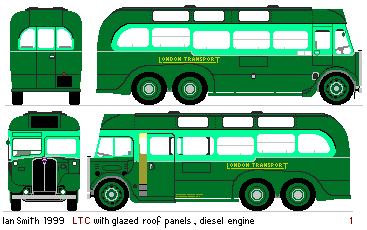
The Private Hire LTCs: LTC1-24 (total 24) 1LTC1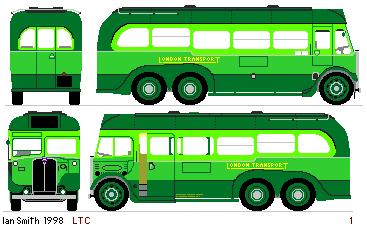 The LTC coaches for London Transport were SHORT six-wheelers.
That is, they were 3ft less than the legal limit for single-decker six-wheelers of 30ft.
At 27ft long they were even shorter than their immediate design
predecessors, the 9T9
coaches for Greenline, which were 27ft 6in long.
The LTC coaches for London Transport were SHORT six-wheelers.
That is, they were 3ft less than the legal limit for single-decker six-wheelers of 30ft.
At 27ft long they were even shorter than their immediate design
predecessors, the 9T9
coaches for Greenline, which were 27ft 6in long.
But London Transport had thought carefully about its private hire market. It had a motley collection of Regals, Tigers and Daimlers that it wanted to replace with a quality product.
Six wheelers were thought to give a smoother ride, but they would have
allowed a thirty foot body (like the ex-Hillman Renown), seating 34,
whereas the shorter wheelbase actually chosen limited the length to 27ft,
and the seating to 30.
Petrol engines were specified even at this late date (1937),
because of their quietness compared with diesels.
In the event the petrol engines were reconditioned units from LT
double-deckers, which received new diesel engines in replacement.
War-timeThus they only had two summer seasons before the outbreak of war in September 1939, when they were requisitioned to work as ambulances. They were modified to carry up to eight stretchers, and carried Emergency Medical Services (EMS) markings as well as their LT fleetnames. Grey, later brown roofs provided some camouflage from aerial bombardment. Some windows were painted over to give privacy to patients. They worked from various Central Area garages for London ambulance work. Five (LTC12-16) were given back their seating in May 1944, for use by walking patients (the ambulant!) Immediately after D-day in June 1944 five were allocated or use by the Canadian Hospital at Wokingham, to cope with the Canadian casualties after the landings. A spare was stationed at Staines or Windsor.
Post-WarAn overhaul programme began in November 1946, their first since new in November 1937. Both chassis and bodywork were thoroughly overhauled. The coaches lost their radio aerials, semaphore trafficators and internal loudspeakers, and gained stencil holders for garage plates and running numbers. They were repainted into the post-war two-tone GreenLine livery, like the 10T10s.
A major change in 1950 was the substitution of 8.8 litre diesel engines (from scrapped LT double-deckers) which stretched them to 27ft 3in. They worked alongside TF9 (the only private hire TF to survive the war) until the private hire RFs and the RFWs arrived in 1951. Even then they soldiered on, finding plenty of work during the Festival of Britain in 1951. Some are said to have received the post-war Country livery of Lincoln green with cream lining,but I have not located a photo (that in the 1950 Hambley book is NOT one). Finally redundant, eighteen were retired at the end of October 1951, with the final six (LTC 1, 9, 10, 18-20) following after the 1952 season. They were sold for scrap in 1952-3, although some chassis were reported exported to Spain.
|
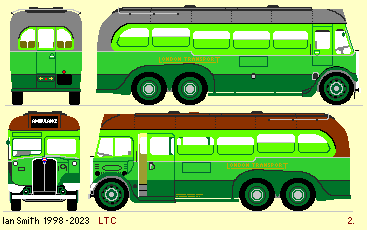
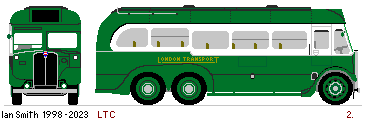 When they returned from war duties at the very end of 1945
they went into store to await refurbishment.
Some were repainted in green and white, and regained their coach seating, and returned to
service, including limited private hire and half-day Windsor tours, in March/April 1946.
They were allocated to Tottenham (13,15), West Green (18,20), Willesden (1-3,5), Palmers Green (6,7, 22), Old Kent Road (9,23) and Chelverton Road (11,19, 21). The rest, still in faded pre-war livery, but with seats reinstated, were diustributed among Croydon, Victoria and Hounslow.
When they returned from war duties at the very end of 1945
they went into store to await refurbishment.
Some were repainted in green and white, and regained their coach seating, and returned to
service, including limited private hire and half-day Windsor tours, in March/April 1946.
They were allocated to Tottenham (13,15), West Green (18,20), Willesden (1-3,5), Palmers Green (6,7, 22), Old Kent Road (9,23) and Chelverton Road (11,19, 21). The rest, still in faded pre-war livery, but with seats reinstated, were diustributed among Croydon, Victoria and Hounslow.
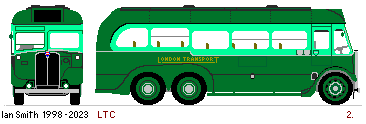
 London Transport had more pressing immediate concerns than Private Hire work,
and the LTCs often found themselves on Greenline coach work or even central bus duties.
About half the class were allocated to Country garages in 1947, to help out,
while the others did sporadic private hire work and rush hour extras in the Central Area.
Neither Greenline nor stage carriage work suited them,
as the narrow gangways
inhibited free movement of both passengers and conductor,
and their fuel consumption was colossal.
(I wonder if it was more than a Leyland National?)
Their weight (8tons 5cwt) also meant that they were slow in stop-start work.
London Transport had more pressing immediate concerns than Private Hire work,
and the LTCs often found themselves on Greenline coach work or even central bus duties.
About half the class were allocated to Country garages in 1947, to help out,
while the others did sporadic private hire work and rush hour extras in the Central Area.
Neither Greenline nor stage carriage work suited them,
as the narrow gangways
inhibited free movement of both passengers and conductor,
and their fuel consumption was colossal.
(I wonder if it was more than a Leyland National?)
Their weight (8tons 5cwt) also meant that they were slow in stop-start work.
 LTC histories
 Bus Stop
 LT index.
 Part 6: Green LTLs.
 LTCs.
LTCs.